Chiesa di Santa Maria di Gallana

On the old Via Appia, coming out of Oria towards Latiano, stands the Church of Santa Maria Gallana, a jewel of sacred architecture that bears witness to a distant past, immersed in the Apulian countryside.
The church is part of a larger complex of buildings, whose archaeological and historical studies date the construction of some structural elements, the apse in particular, to the 6th century, on top of Roman constructions. Only between the 9th and 10th centuries did the church acquire its current structure with the nave and the traditional trullo domes. Due to its location on the Appian Way, it was often the site of different settlements, which determines its unique character in which modifications from successive eras are added together and the various stylistic influences, Roman, Christian and Byzantine, converge in a harmony with a Mediterranean flavour.
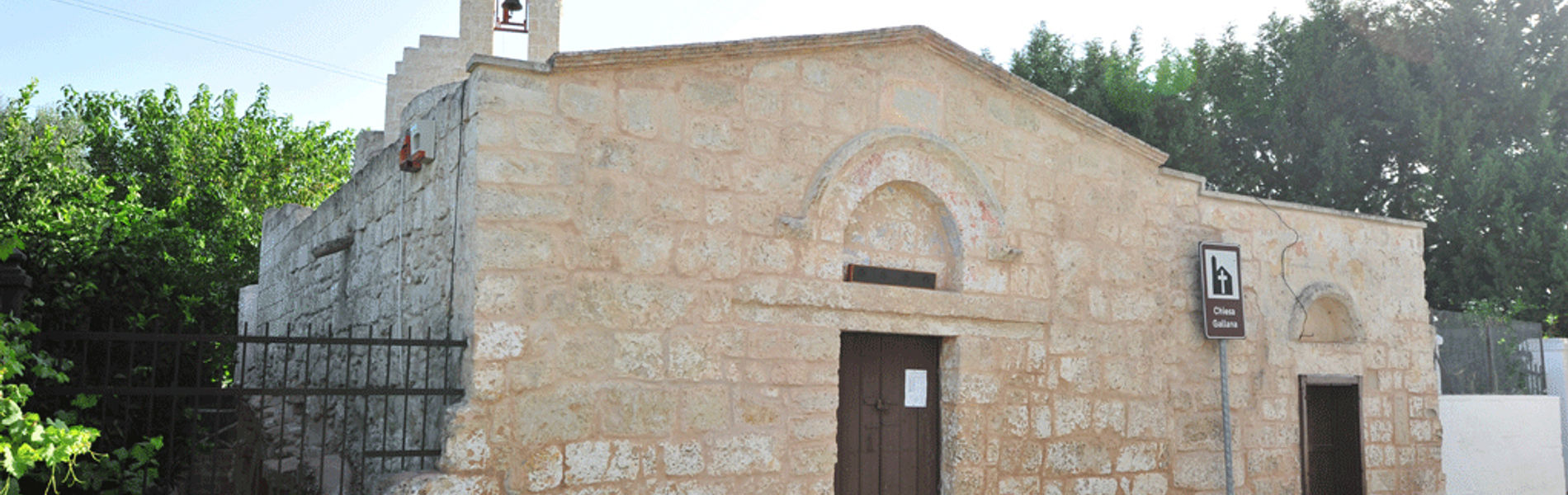
The current structure shows signs of the many renovations and transformations: with a rectangular plan and a single nave that closes with an apse, it is characterised by two domes (originally three as there was also a transept) with a typical cone-shaped 'trullo' appearance, flanked by a bell gable built together with the façade in a later period (18th century). On the southern side, there is a cylindrical structure, now plastered over, which has led to the hypothesis of the presence of an additional baptistery in the complex.
The linear simplicity of the monocuspidal façade, with its lunetted portal flanked by ancient stone benches and a second entrance belonging to the adjacent villa, welcomes the visitor into an intimate and peaceful atmosphere that combines remote events and an intact sacredness, in an environment that holds fascinating traces of the many passages of indigenous and Mediterranean civilisations.
Exploration of this church requires curiosity and a keen eye for detail, for behind its apparent sobriety lie relics, frescoes and construction elements that will tell an ancient and rich story to those who will stop to listen.


